The Two Breaking Points: What WeWork Reveals About Strategy and Execution
The Two Breaking Points
What WeWork reveals about where strategy actually falls apart — and when
Most WeWork post-mortems start with Adam Neumann.
That is understandable. It is also incomplete.
The more useful question is not why one founder made reckless decisions.
It is how thousands of intelligent people continued executing assumptions that were never structurally validated.
And how a company could commit billions to a model whose load-bearing assumptions had never been seriously pressure-tested.
We ran Stratimind in a pre-commitment mode, locked to August 14, 2019 and limited to information publicly available at that moment. Over the course of the assessment, the system stripped the case down to the assumptions that were actually carrying the strategy.
That was the first breaking point.
The second came later: once those assumptions were embedded into the organization, thousands of people began executing them as if they were facts.
That is where many companies truly break.
Part I — The first breaking point: before commitment
By August 2019, WeWork was being valued like a technology company. But its economics behaved more like a leveraged real-estate operator.
That mismatch mattered.
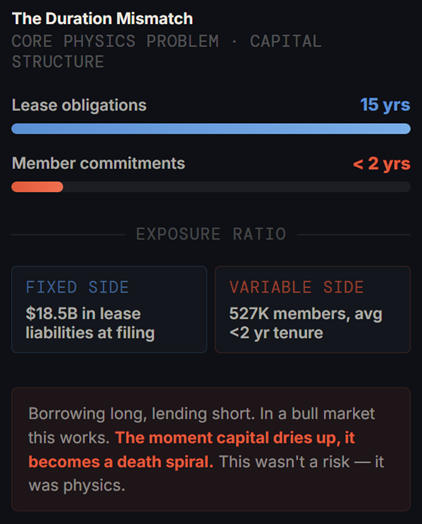
Tech models can absorb aggressive growth because margins can scale quickly. Lease-heavy models cannot. Yet capital was deployed as if WeWork belonged to the first category.
The Stratimind assessment did not begin with a conclusion. It began by breaking the story into its underlying components and separating the narrative from the physics.
What emerged were four assumptions.
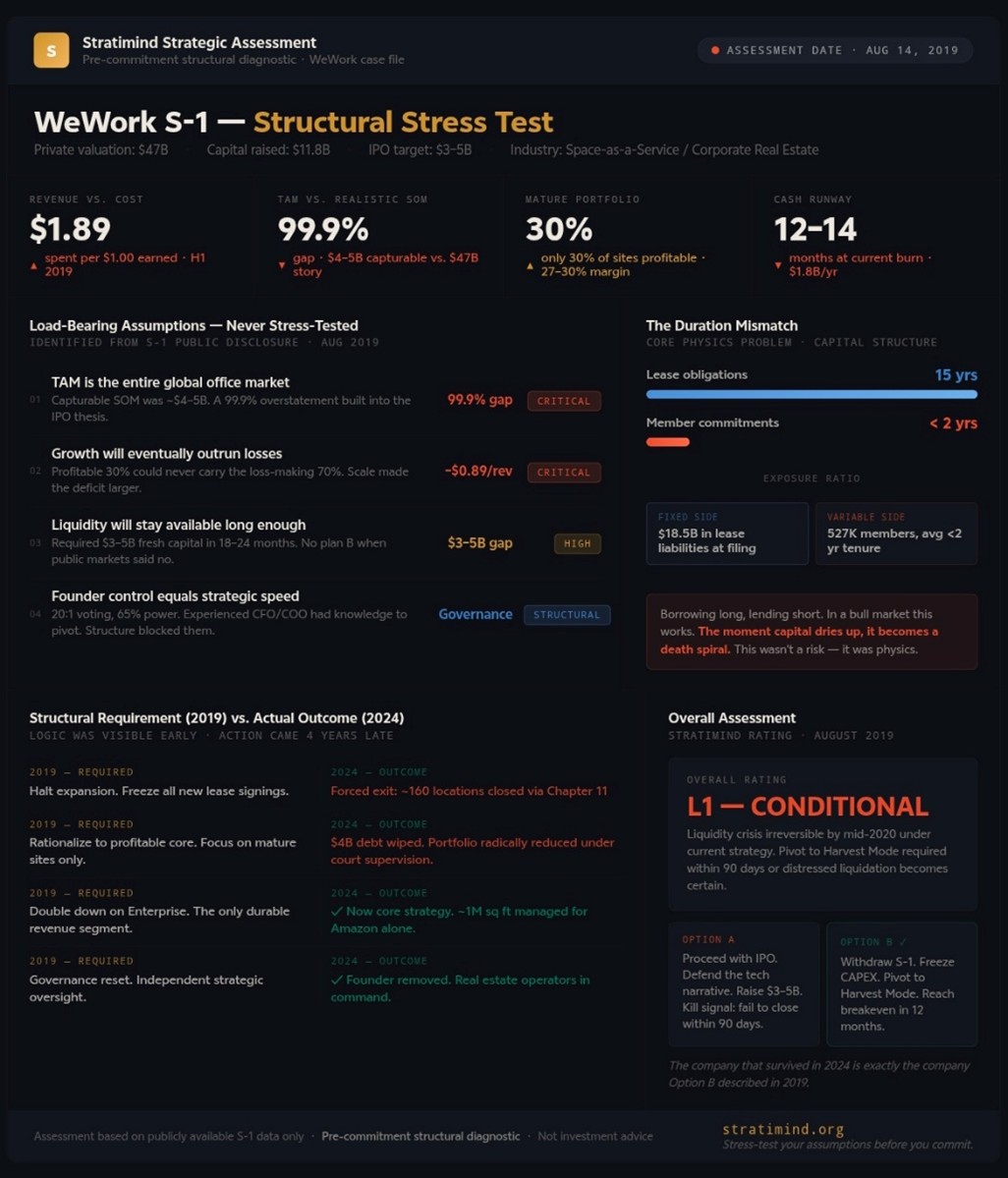
Market size. WeWork's S-1 described a total addressable market of roughly $945 billion to $1.6 trillion. The assessment showed that the capturable market, given WeWork's actual operating footprint and constraints, was far narrower. My estimate placed it closer to a high-single-digit or low-double-digit billion-dollar opportunity. The exact number matters less than the gap: the narrative was far larger than the operational ceiling.
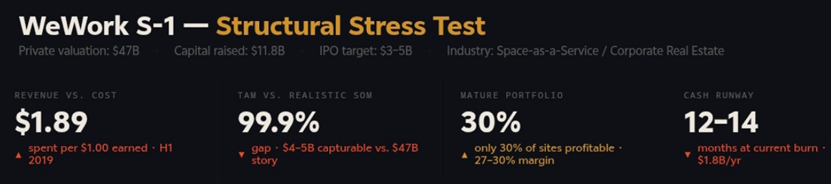
The path to profit. The public H1 2019 disclosure showed total operating costs running at 189% of revenue. In plain English, the company was spending far more than it earned. Management framed this as an investment phase. The belief was that scale would eventually bring costs in line with revenue.
The problem was structural. The longest-running locations, open more than 24 months, were generating healthy contribution margins of around 27% to 30%. But those mature locations were only 30% of the portfolio. The other 70% was still being built out, still burning cash, and still years away from maturity. Growing faster did not shrink that gap. It made it larger.
Capital availability. The strategy required roughly $3 billion to $5 billion in fresh capital within 18 to 24 months just to reach the point where the business generated more cash than it spent. That capital was supposed to come from the IPO. There was no clearly articulated fallback if the IPO did not close on the terms required.
When public markets read the S-1 and pushed back, there was no backup plan. The financial architecture assumed the funding would arrive.
Governance. The company's 20:1 voting structure gave Adam Neumann majority voting control. WeWork's CFO, Artie Minson, had lived through the AOL–Time Warner collapse. He understood what unsustainable scale looked like at its endpoint. So did the COO. The organizational knowledge to course-correct existed inside the company.
But the same structure that protected the vision also made it structurally difficult to revise that vision, even when the people closest to the numbers understood it needed to change.
None of these assumptions were hidden. All four were visible in the public S-1 filing, using publicly available data. They just were not being treated as assumptions. They were being treated as foundations.
That is the first breaking point: commitments made before the load-bearing logic was tested.
The cost at that stage is still manageable. The assumptions are identifiable. The capital has not yet been fully deployed. The organization has not yet built its entire operating system around those assumptions.
That changes quickly once commitment is made.
Continue the Conversation
Most leadership challenges don't appear all at once.
They emerge gradually through small shifts in decision-making, execution, alignment, and accountability.
Each month I share a short executive briefing exploring the leadership, sales, and execution patterns I see repeatedly inside growing organizations.
These aren't marketing emails.
They're structured observations designed to help leaders think more clearly about growth, alignment, decision-making, and revenue performance.
Part II — The second breaking point: when assumptions enter the operating system
Once leadership commits to a thesis, organizations rarely receive it as a hypothesis. They receive it as instruction.
This is where strategy stops being analysis and becomes operating reality.
At that point, the story stops being strategic and starts becoming operational.
The instruction reaches every layer of the organization. And each layer adapts — not by questioning the logic, but by translating it into motion.
That is how a company starts to break from the inside.
Not all at once. Decision by decision. Team by team.
The strategy does not collapse visibly.
It fragments.
And by the time the fragmentation becomes obvious, the company has already spent months or years turning a fragile thesis into a daily operating system.
That is the second breaking point.
Not that the strategy was flawed.
That the company kept executing it after the flaw should have become visible.
The question is not just that it broke. The question is how it broke — what the operating system looked like from the inside, while it was still appearing to function.
What the organization receives as strategy, it begins to treat as truth. And once something is treated as truth, the system stops questioning it and starts scaling it.
Inside the system, this shows up as a chain of quiet adaptations.
Qualification widens first, not by design, but because the growth expectation demands it. As qualification loosens, pipeline volume increases but predictability falls. Forecasts begin to rely more on optimism than on consistent standards. KPIs, built to measure activity rather than outcome, begin rewarding motion over conversion deals are moving, reports are being generated, growth narratives remain intact. And as each team interprets the underlying assumptions differently in real time, decision-making loses its consistency. Similar situations are handled differently across managers, not because the strategy changed, but because no one is working from the same version of it anymore.
Revenue teams rarely experience this as a strategic issue. They experience it as pressure. Targets remain. Expectations remain. Activity increases. But because the underlying assumptions are no longer being interpreted consistently, effort begins replacing clarity. Leaders start coaching behavior that is actually structural in nature. More meetings, more pipeline reviews, and more accountability are introduced into a system that has quietly lost alignment around how decisions are made.
At this stage, the system still appears to function.
But the underlying driver has shifted.
Momentum is no longer driven by validated assumptions.
It is being maintained by effort.
This is why the second breaking point is harder to detect. Nothing collapses immediately. The system fragments quietly. And by the time the inconsistency becomes visible, the organization has already operationalized a version of the strategy that no longer reflects its original logic.
This is where the two failure points connect.
The issue is not only that assumptions were incomplete before commitment.
It is that once committed, they are no longer treated as assumptions at all.
They are treated as truth.
And execution scales that truth, whether it holds or not.
The Cost of Discovering It Late
When organizations operationalize untested assumptions, the consequences rarely appear as a single failure.
They appear as:
forecast instability
qualification inconsistency
longer sales cycles
declining conversion efficiency
increased management intervention
rising cost of growth
By the time those symptoms are visible, the organization is often spending significant energy correcting execution that was never the original problem.
Part III — What the post-bankruptcy company revealed
The most interesting part of the WeWork story is not that it collapsed.
It is what emerged from bankruptcy later.
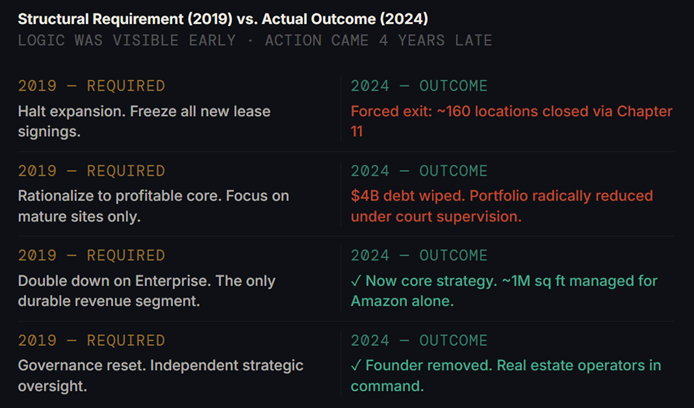
The post-bankruptcy company was smaller, more disciplined, and more focused on enterprise demand. In other words, the business that survived looked much closer to what the structural logic had implied all along.
That correction was not mysterious.
It was delayed.
And delay is expensive.
The lesson here is not that ambition is bad. It is that ambition without structural clarity is expensive.
Strategic clarity breaks in two places:
before commitment, when assumptions are not truly stress-tested,
and after commitment, when those assumptions are handed to the organization as if they were facts.
Most leaders only discover this in the wrong order.
Lessons Learned:
Most strategic failures happen twice.
First when assumptions are mistaken for facts.
Then when execution scales those assumptions throughout the organization.
The first failure is strategic.
The second is operational.
The first version is cheaper to fix, if you have the tools to see it.
The second is devastatingly expensive.
That is why WeWork is not just a cautionary tale about founder excess.
It is an unusually visible example of a pattern that appears inside organizations of every size.
Assumptions become accepted as facts.
Facts become operating instructions.
And execution continues long after the original logic should have been questioned.
The companies that avoid this fate are rarely the ones with the best strategy.
They are the ones that continuously test whether the assumptions underneath the strategy still hold.
Most organizations discover execution problems long after the underlying assumptions have already entered the operating system.
By then, leaders are often trying to correct performance when the real issue began much earlier.
The Executive Clarity Assessment helps identify where decision consistency, leadership alignment, and execution pressure may already be diverging before those costs become visible in performance.
About the Authors
Kal Jurdi is an Executive Clarity Architect, leadership advisor, and author of Sell Without Selling Out. He helps CEOs and sales leaders identify execution pressure, revenue friction, and decision-consistency gaps before they become performance problems. His work focuses on how strategic direction changes as it moves from leadership intent into organizational execution.
Sophia Xiong is the founder of Stratimind, an independent strategic diagnostic platform that helps founders, executives, and investors stress-test major business decisions before capital, time, and reputation are committed. Drawing on a legal background, capital markets and ESG investing experience, strategic advisory work, and firsthand entrepreneurial experience, she helps leaders surface the assumptions most likely to break a strategy before they become expensive reality.

